What is interoperability? And how does MIDRC operate with other NIH repositories?
What enables datasets, tools, and models to work together across repositories and research communities? Interoperability supports collaboration, reproducibility, and the efficient reuse of medical imaging resources, helping researchers build on existing data and infrastructure. Built on the Gen3 platform, MIDRC was designed with interoperability in mind to support connections that extend the reach and impact of its data, tools, and infrastructure. This video (also available on YouTube) and corresponding slide deck explore what interoperability is, why it matters, and how it can help advance medical imaging research.
From FAIR data to SAFE cloud environments.
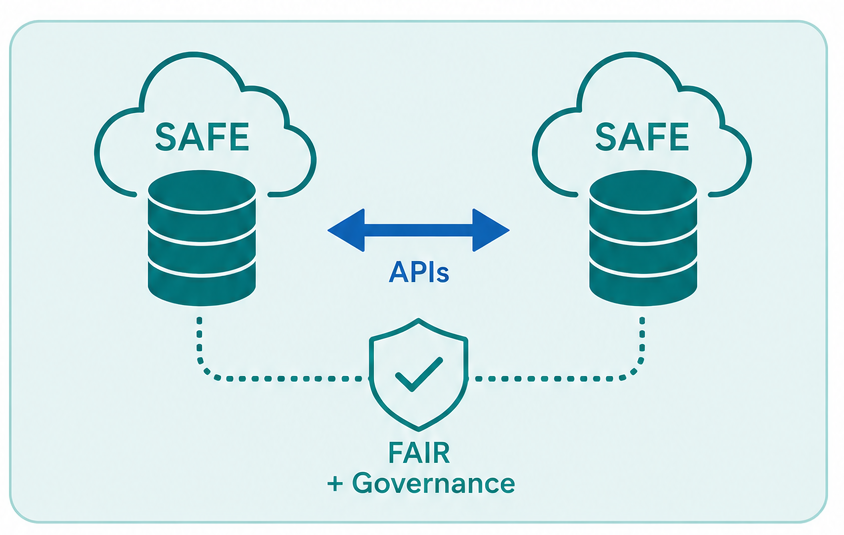
As the number of cloud platforms supporting scientific research grows, there is an increasing need to support interoperability between two or more cloud platforms. A well accepted core concept is to make data in cloud platforms Findable, Accessible, Interoperable and Reusable (FAIR). We introduce a companion concept that applies to cloud-based computing environments that we call a Secure and Authorized FAIR Environment (SAFE). SAFE environments require data and platform governance structures and are designed to support the interoperability of sensitive or controlled access data, such as biomedical data. A SAFE environment is a cloud platform that has been approved through a defined data and platform governance process as authorized to hold data from another cloud platform and exposes appropriate APIs for the two platforms to interoperate.
Grossman, R.L., Boyles, R.R., Davis-Dusenbery, B.N., Haddock, A., Heath, A.P., O’Connor, B.D., Resnick, A.C., Taylor, D.M. and Ahalt, S., 2024. A framework for the interoperability of cloud platforms: Towards FAIR data in SAFE environments. Scientific data, 11(1), p.241. https://doi.org/10.1038/s41597-024-03041-5
Building connected data ecosystems.
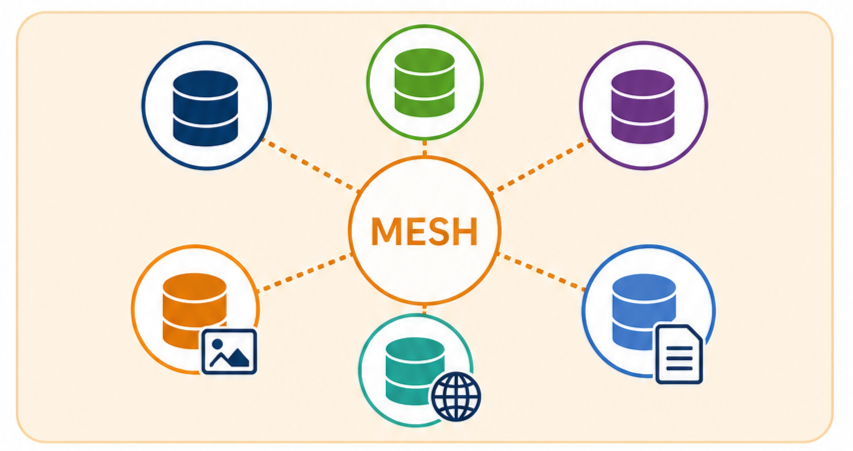
Over the past few years, a growing number of data platforms have emerged, including data commons, data repositories, and databases containing biomedical, environmental, social determinants of health and other data relevant to improving health outcomes. With the growing number of data platforms, interoperating multiple data platforms to form data meshes, data fabrics and other types of data ecosystems reduces data silos, expands data use, and increases the potential for new discoveries. In this paper, we introduce ten principles, which we call pillars, for data meshes. The goals of the principles are 1) to make it easier, faster, and more uniform to set up a data mesh from multiple data platforms; and, 2) to make it easier, faster, and more uniform, for a data platform to join one or more data meshes. The hope is that the greater availability of data through data meshes will accelerate research and that the greater uniformity of meshes will lower the cost of developing meshes and connecting a data platform to them. The principles are divided as follows: four pillars apply to a data platform that wants to join a data mesh; five pillars apply for setting up and operating a data mesh; and, one pillar applies to data platforms that provide analysis environments for meshes. When there is some level of consensus, we reference standards and identify community best practices.
Grossman, R.L., Boyd, C., Do, N., Elbers, D.C., Fitzsimons, M.S., Giger, M.L., Juehne, A., Larrick, B., Lee, J.S., Lin, D. and Lukowski, M., 2024. Ten pillars for data meshes. arXiv preprint arXiv:2411.05248. https://doi.org/10.48550/arXiv.2411.05248
HEAL: A real-world example of interoperability.
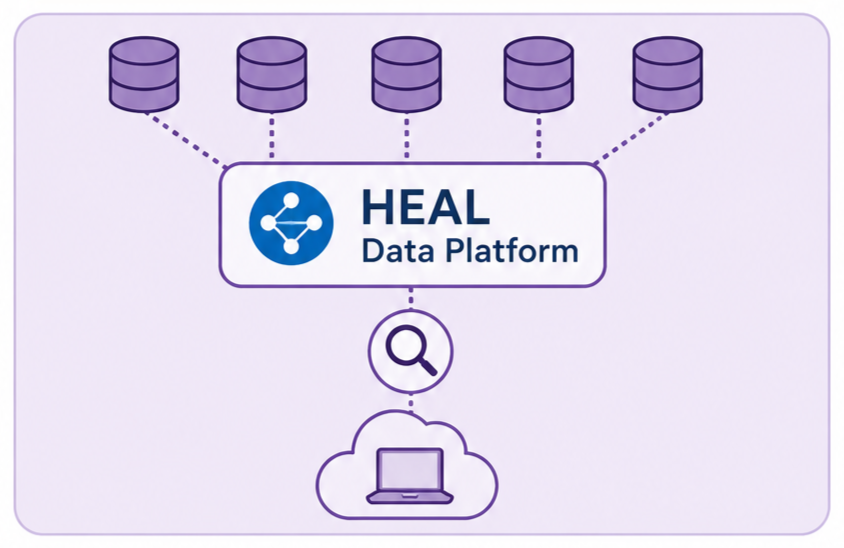
The HEAL Data Platform is built on the open source Gen3 platform, utilizing a small set of framework services and exposed APIs to interoperate with both NIH and non-NIH data repositories. Framework services include those for authentication and authorization, creating persistent identifiers for data objects, and adding and updating metadata. The HEAL Data Platform serves as a single point of discovery of over one thousand studies funded under the HEAL Initiative. With hundreds of users per month, the HEAL Data Platform provides rich metadata and interoperates with data repositories and commons to provide access to shared datasets. Secure, cloud-based compute environments that are integrated with STRIDES facilitate secondary analysis of HEAL data. The HEAL Data Platform currently interoperates with nineteen data repositories. Studies funded under the HEAL Initiative generate a wide variety of data types, which are deposited across multiple NIH and third-party data repositories. The mesh architecture of the HEAL Data Platform provides a single point of discovery of these data resources, accelerating and facilitating secondary use. The HEAL Data Platform enables search, discovery, and analysis of data that are deposited in connected data repositories and commons. By ensuring that these data are fully Findable, Accessible, Interoperable and Reusable (FAIR), the HEAL Data Platform maximizes the value of data generated under the HEAL Initiative.
Larrick, B.M., Schumm, L.P., Shao, M., Barnes, C., Juehne, A., Juvvla, H.P., Kranz, M.B., Lukowski, M., Malson, C., Mazerik, J.N. and Meyer, C.G., 2025. The HEAL Data Platform. arXiv preprint arXiv:2512.17506. https://doi.org/10.48550/arXiv.2512.17506
Interoperability.
Last updated July 8, 2026