MIDRC-Global.
MIDRC has been awarded a generous grant from the Chan Zuckerberg Initiative DAF, an advised fund of Silicon Valley Community Foundation, to fuel the development of MIDRC-Global, an international initiative aimed at expanding the MIDRC data commons to transform medical imaging research on a global scale.
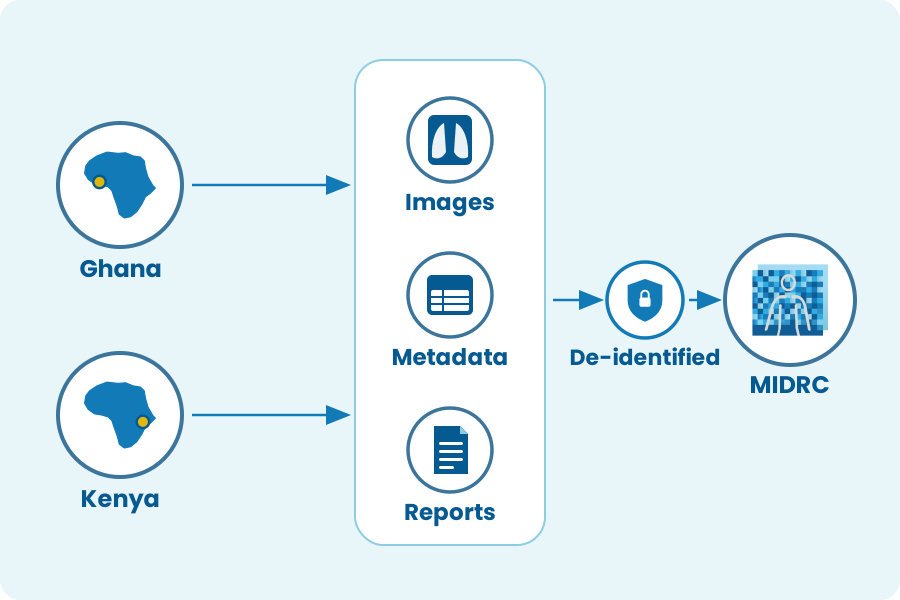
MIDRC-Global brings together collaborators in Kenya (Dr. Loice Jeruto Sitienei and the team at Moi University College of Health Science) and Ghana (Dr. Jane Afriyie-Mensah and the team at the University of Ghana Medical School) to collect medical imaging data from different regions of Africa and expand MIDRC’s data commons. The project is co-led by MIDRC investigators at the University of Chicago and Emory University.
The effort focuses on lung fibrosis as seen on chest radiographs and chest CT. Lung fibrosis, the progressive scarring of lung tissue, is a strong candidate for AI/SI development, but well-characterized public datasets that reflect the patients and clinical workflows of African health systems are scarce.
To fill this gap, MIDRC-Global is building a representative dataset that supports the development of AI/SI tools for diagnosis and treatment. Each clinical site is targeting 400-600 cases, roughly two-thirds CT and one-third chest X-ray, with about 10% non-fibrotic controls. Imaging will be linked to clinical, demographic, and radiology report information relevant to fibrosis, including fibrosis subtype, comorbidities, smoking and TB history, and pulmonary function testing, if available.
By adding these datasets to MIDRC’s publicly available, AI/SI-ready data commons, MIDRC-Global will let researchers train and test fibrosis detection and characterization algorithms on more diverse populations, and see whether tools developed elsewhere hold up in African clinical settings. Through open-access resources and responsible data-sharing mechanisms, the project aims to advance AI/SI tools that support earlier, more accurate diagnosis and better prognosis for patients with lung fibrosis, and to and to underscore that AI/SI can benefit patients only if the data used to build it represent the intended population. Most of the data will be publicly available, with a portion held in a sequestered set for independent evaluation of algorithms.
Where the project stands
Data model: Fibrosis-specific requirements have been added to the MIDRC data model, and a standardized clinical data submission template is being tested by both sites.
De-identification and transfer: Site teams were trained on the RSNA de-identification tool and on an LLM-based approach to de-identifying text. Both sites have completed initial transfers of de-identified test cases with associated metadata.
Validation: RSNA is validating ingestion and reviewing the test cases. Lessons from this phase will shape larger-scale submissions.
Next steps: Broader case submission will follow validation, with the dataset planned for release in 2027
This work supports
Expanding data collection globally, creating a more comprehensive resource for researchers
Improving data organization and processing, making the data easier to use for AI/SI development
Enhancing the MIDRC user portal, enabling broader access and collaboration for AI/SI researchers worldwide
Last updated November 3, 2026

MIDRC Global is funded by grant 2024-354607 from the Chan Zuckerberg Initiative Donor Advised Fund (DAF), an advised fund of Silicon Valley Community Foundation.